Rough seas at Ponta da Piedade: when tours get cancelled
Updated August 24, 2026 · 7 min read
The most common disappointment on the Algarve is not bad weather. It is a cloudless day on which no boat leaves anyway. The sky is blue, the terrace is warm, and down at the pontoon a skipper shakes his head and points at the water.
The weather that decides your grotto trip does not happen above you. It happens in front of you: the swell. It rolls in from the Atlantic and needs no local wind to be there. Once you understand that, you book differently — and you are disappointed less often.
Why grottoes in particular are so sensitive
A grotto is a stone box with exactly one way out. When swell runs into it, the confined space makes the wave taller rather than smaller, and it bounces back. A boat sitting inside has no room to dodge and no time to turn. That is why operators at Ponta da Piedade call things off at wave heights that would be perfectly workable out in open water.
Then there is headroom. Several of the small passages are only open around low to mid tide. A rising tide plus swell means the boat sails but the cave stays shut.
The order in which things get cancelled
Not everything falls over at once. There is a fairly reliable pecking order:
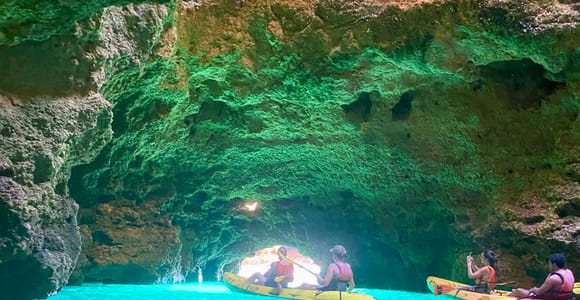
- Kayak and SUP. Narrowest, lowest to the water, first to go. Guided kayak tours need calm sea because a group of eight has to be able to turn around inside a cave.
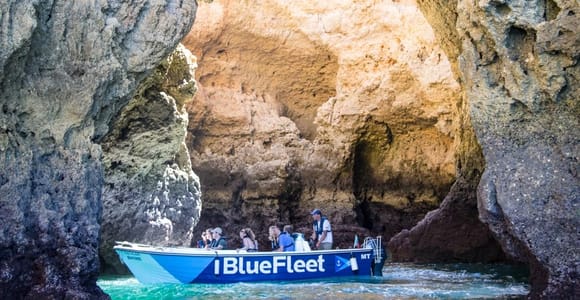
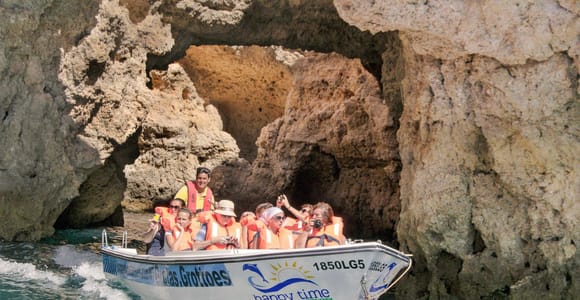
- Small grotto boats. The open launches and the shallow motorboats that actually go inside. They often still run, but with a shortened route.
- RIBs and speedboats. They handle waves well but uncomfortably — in swell the ride turns hard and wet.
- Catamarans and sailing boats. Last to stand down. They pass the headland rather than enter it, which is exactly why the grotto question affects them least.
In practice: on a marginal day the catamaran cruise from €23.20 is often the only thing still sailing. It shows you the rock formations from outside. If that is enough for you, you have your day on the water.
Mornings are calmer, and the reason has a name
In summer the western Algarve gets a north-westerly that builds almost daily — the nortada. It usually sets in during the late morning and strengthens through the afternoon. The result is a short, steep wind chop on top of the underlying swell: unpleasant, and the reason many skippers skip passages in the afternoon that they took that same morning.
Hence the single most useful booking rule for Lagos: take the first or second departure of the day. It is calmer, the light inside the grottoes is better, and the odds of the tour running at all are higher.
What you can check yourself
Portugal’s weather service, IPMA, publishes a significant wave height forecast and issues agitação marítima warnings by district — Faro covers the Algarve. Yellow means a risk for weather-dependent activities; orange means a moderate-to-high hazard.
One thing to keep in proportion: when winter reports circulate about six- to eleven-metre waves in Portugal, those figures almost always refer to the west coast. The south coast, where Lagos sits, is considerably more sheltered. Even so, Atlantic depressions roll through regularly from November to March, and when they do the grotto boats stay in for days.
Cancellation, shortening, rebooking — the three cases
The genuine cancellation. The operator gets in touch, usually the evening before or that morning. The standard offer is a choice between another slot and a full refund. Most listings also carry free cancellation up to 24 hours before departure — which terms apply is stated on each listing.
The shortened route. The more common case, and the one nobody talks about enough. The tour runs, but the tight passages are dropped. That is not a breach of contract, it is seamanship, and there is usually no refund for it. Ask before you board what is on the route today.
The shift by a few hours. With offshore wind or a turning tide, operators will often offer a later departure. If you are already in town, that is usually the best option available.
How to protect yourself
Book early in your stay, not on your last day. That leaves room for a second attempt. Book in the morning. And for a week-long trip, earmark two possible days for the water rather than one — it costs nothing and it removes the only real disappointment this coast has to offer.
If you are choosing between a local run and a longer passage: on unsettled days, shorter is better. The 75-minute Ponta da Piedade loop from €16 stays close inshore; the run to Benagil spends two hours over open water. Why that is a trade-off even in fine weather is covered in from Lagos to Benagil.
And if nothing sails at all?
Then there is the land side, which here is unusually good. The clifftop paths above Ponta da Piedade are free and spectacular on windy days — details in Ponta da Piedade on foot. Beyond that there are things to do on land from €5, from wine tasting to a jeep tour into the hinterland.
And for tomorrow’s booking: which hull gets in at which water level is settled in which boat gets into the grottoes. All current departures are listed under Ponta da Piedade boat tours.
A cancelled tour is annoying. It is also the judgement of someone who runs this coast eight times a day and knows what will not work today. That is the kind of news you are glad about afterwards.