Boat or kayak at Ponta da Piedade: which one is right for you
Updated September 4, 2026 · 6 min read
Almost every booking in Lagos comes down to one question, and it is not a matter of taste: boat or kayak. Both go to the same rock pillars, the same arches, the same handful of caves. After that, the similarity ends.
The market has already decided: the grotto boats category lists 65 listings, the kayak tours category 21. That does not mean the boat is better. It means it suits more people.
The short version
| Grotto boat | Kayak | |
|---|---|---|
| Listings | 71 | 21 |
| Cheapest price | from €16 | from €19.43 |
| Median | €40 | €40 |
| Total reviews | 48,809 | 22,438 |
| Typical duration | 75 minutes | 2 to 2.5 hours |
| Gets you wet? | no | yes |
| Guide explains? | throughout | in between |
| Cancelled for wind | less often | more often |
The median sits at €40 for both. The difference is at the bottom: a grotto boat starts at €16, a kayak seat at €19.43. The really cheap seats are only on the boat side — for instance the guided boat trip to the rock formations for €17.40, 75 minutes, 4.8 stars from 3,466 reviews.
Duration: an hour and a half against half a morning
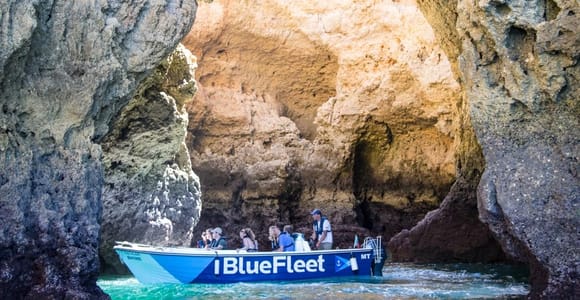
The classic grotto trip from Lagos lasts 75 minutes. You board at ten and you are back in a café by quarter past eleven. The most booked of these trips costs €22.50 and has 4,048 reviews at 4.9 stars.
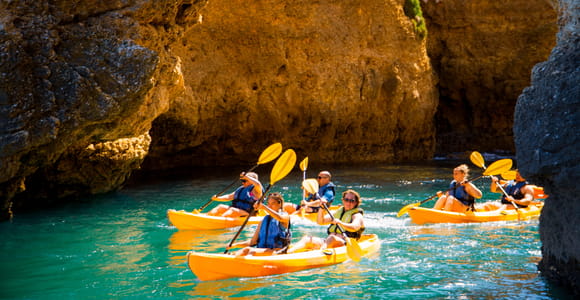
Kayaking takes 2 to 2.5 hours — plus changing, a briefing and a wet ride back to the hotel. Realistically, half the morning is gone. The full guided kayak tour runs €34 for 2.5 hours, the shorter kayak experience €28 for 2 hours.
What the kayak actually has going for it
Only one thing, but it is the decisive one: tightness. A kayak fits through passages no hull can enter, and you sit at water level instead of a metre and a half above it. You touch the rock. You hear the water breathe inside a cave instead of having an engine at your back. Most tours build in a swim stop at one of the small beaches along the way.
Which hull gets in how far, conversely, is covered in detail in which boat gets into the grottoes. Short version: bigger means drier and calmer, but also further out.
Weather: the kayak is more sensitive
Both depend on the sea, but not equally. A boat still goes out in conditions that already keep kayaks tied to the pontoon — and if the swell is strong enough, the boat trip gets cancelled too. What happens then and how to protect your booking is covered in boat tours and rough seas.
In practice that means: put the kayak on your first day in Lagos, so there is still room for a second attempt.
Photography: the underrated point
On the boat you shoot sitting down, with dry hands and whatever camera you like. In a kayak both hands are on the paddle, salt water drips off the blade, and anything without a waterproof housing is a risk you carry yourself. The subjects are closer and more dramatic — but you only bring them home with a waterproof camera or a very good phone case. If you are attached to your gear, the boat suits you better.
Physically: not a workout, but not sitting still either
Two hours of paddling in a sheltered bay is manageable for healthy adults even without prior experience. You will still feel it in your shoulders and back the next day. The hard part is not the caves but the open stretches between them, when the wind is against you. Life jackets are standard on these tours; you should feel comfortable on open water. Whether kids can come along is a separate question: kayaking with kids — minimum age.
The hybrid: boat out, kayak in
This is the most interesting option, and the reason some kayak tours cost more. A motorboat takes you from the harbour to the rocks, you switch into kayaks there and paddle only the scenic part. The long approach falls away, so you get more time between the arches instead of getting there. This combination runs €40, 2 hours, 4.9 stars from 2,952 reviews — the best-rated kayak option in the listings.
If you are unsure whether two hours of paddling would be too much, book this version. The twelve-euro premium over the plain kayak experience buys you exactly the energy you would otherwise spend on the way out.
Time of day
For the kayak there is only one right answer: early. In the morning the water lies flatter, the afternoon wind has not arrived yet, and between ten and two the boats crowd into the same passages — their wash makes paddling choppy. The boat copes with midday better. For the evening there is the sunset cruise, which shows a completely different coastline.
Who the kayak is the wrong choice for
Honestly, without dodging it: if your back or shoulders worry you, if someone in your group is not comfortable on open water, if you only have half a day, if an expensive camera is coming along, or if you would rather watch and listen than work — then the kayak is not the braver choice, it is the worse one. There is no prize for having booked the harder option.
If you want to stay dry but be out longer than 75 minutes, that is what the catamaran tours offer: 2.5 hours from €20, though further from the rock.
The recommendation
Athletic adults, two people, at least two days in Lagos: the kayak, specifically the version with a boat transfer, in the morning. This is the experience you will still remember in five years.
Families, mixed groups, older travellers, tight schedule, chance of rain looming: the grotto boat, 75 minutes, small rather than large. You see the same coastline, the same arches, the same colours — just from a little further away — and you keep the rest of the day.
If you cannot decide and have three days: both. A boat trip on the first afternoon as an overview, the kayak on the second morning for the closeness. Together that is under €60, and it does not contradict itself.
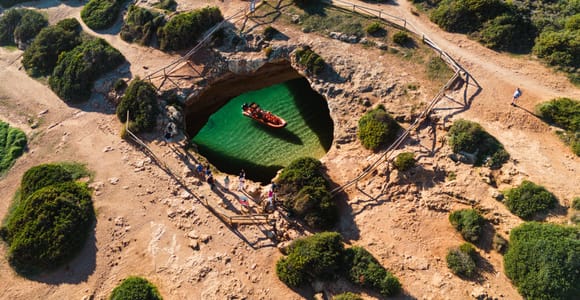
And if you want to look from above before booking anything: the clifftop path costs nothing and shows the headland in its full width — Ponta da Piedade on foot.