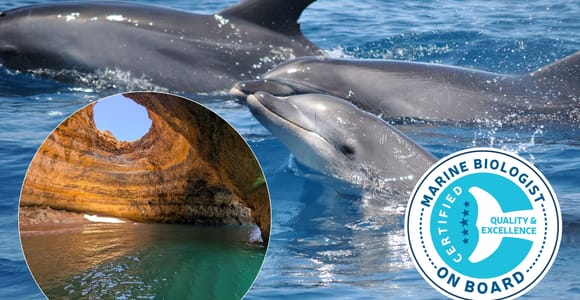
Dolphin Tours from Lagos: What the Marine Biologist on Board Actually Changes
Updated September 9, 2026 · 6 min read
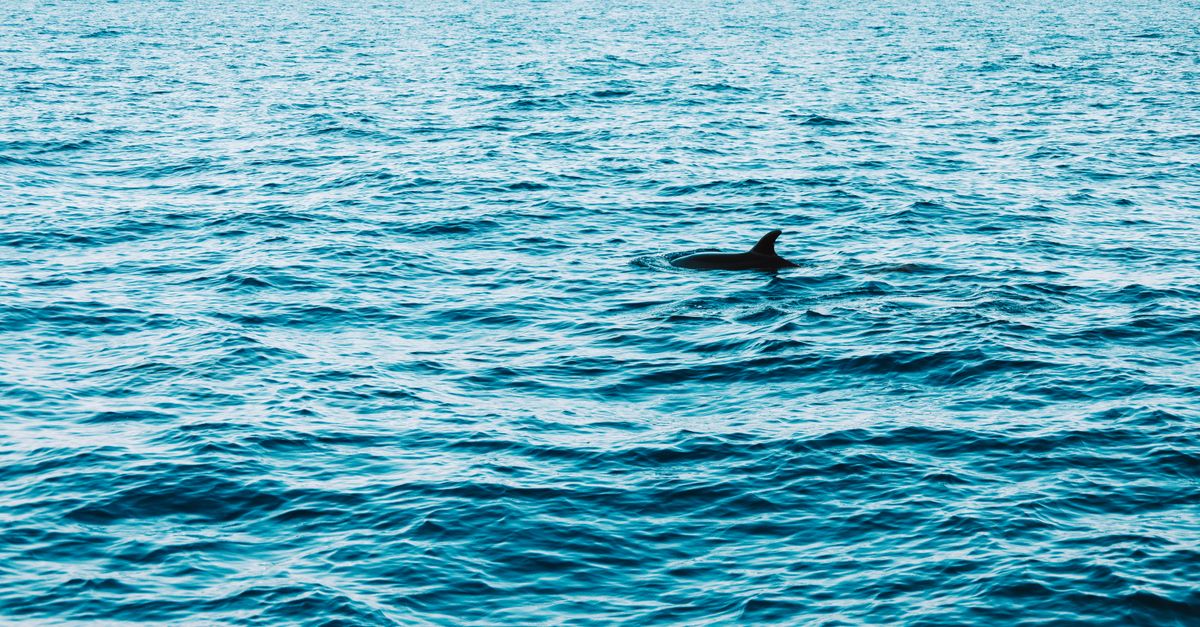
Anyone browsing the dolphin-watching offers in Lagos trips over one striking thing: almost every tour advertises a marine biologist on board. For the four most-booked ones, it’s even in the title. There are eleven offers in total, from €28, with a median of €39, carrying 9,506 reviews between them.
For comparison: a plain coastal tour to Ponta da Piedade starts at €16. So the premium for the dolphin tour is real. The question is what you get for it – and what the expert on board actually accomplishes.
Two Formats That Aren’t Alike
There’s a structure in the numbers that gets lost on the listing pages. There are two basic types:
The pure dolphin tour. 1.5 hours, around €40. Two examples: the Dolphin Watch Tour with Professional Marine Biologist for €40 (4.9 stars, 1,764 reviews) and the Dolphin Watching Tour + Marine Biologist as Guide for €40.75 (4.7, 1,172 reviews).
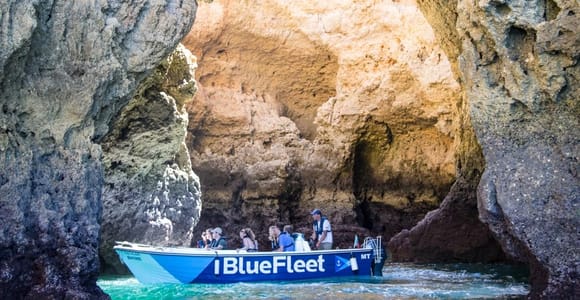
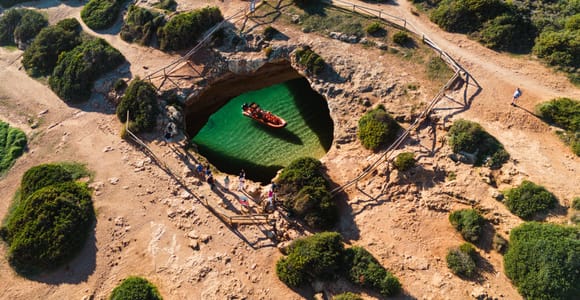
The dolphins-plus-Benagil-cave combination. 2.5 hours, €32 to €39. The Dolphin and Benagil Tour with Marine Biologist costs €39 (4.7, 3,677 reviews), the catamaran version €32 (4.4, 2,153 reviews).
The combination is an hour longer and partly cheaper. That sounds like the better deal, and for dolphins it still isn’t. Benagil lies around 35 kilometres east of Lagos, and the nearest ports to it are Portimão and Carvoeiro, not Lagos. A considerable part of those 2.5 hours goes on the approach along the coast. Dolphins, on the other hand, live out in the Atlantic – for that, boats head several kilometres away from land, in the opposite direction to the cave programme.
In other words: the shorter tour buys you more search time on open water, not less. If you want dolphins, take the 1.5 hours. If you want a varied morning, take the combination – and know that the cave is the main event. What the trip to Benagil otherwise involves is covered in From Lagos to Benagil.
What the Marine Biologist Actually Does
Four things, and none of them is entertainment.
He tells the species apart. Off the Algarve, common dolphins (Delphinus delphis) and bottlenose dolphins (Tursiops truncatus) are the most frequent candidates. Then there are striped dolphins, Risso’s dolphins, and the harbour porpoise – a small, shy relative that specifically avoids boats and is therefore hard to spot. Without someone calling it out, every grey back is just a grey back.
He reads the behaviour. Whether a group is hunting, travelling, or resting decides whether it takes any interest in the boat at all. A good skipper leaves resting animals alone.
He keeps his distance – and explains why. Watching wild whales and dolphins in mainland Portuguese waters is regulated; the basis is Decreto-Lei 9/2006, and operators need a permit from the nature conservation authority. The code of conduct that the marine conservation organisation AIMM Portugal publishes on this requires, among other things: approaching only from behind or from the side, never cutting across in front of the animals, not splitting up a group, no more than three boats within 100 metres, and a limited amount of time spent with the same animals. That’s exactly why your boat sometimes turns away even though everyone still wants to film. A biologist on board is the difference between “the captain is being unfriendly” and “we’re disturbing them right now”.
He puts what you see in context. How big the group is, whether there are calves among them, why the birds are circling over the spot.
What He Can’t Do
Summon animals. That’s not a side note, it’s the core of it. There is no sighting guarantee, and no reputable operator offers one. Some operators offer a second trip if a tour comes back without a sighting – whether that applies to your booking is stated on the relevant booking page and nowhere else. Check it there before you pay, rather than relying on it afterwards.
Why the Early Departure Is the Better One
On the western Algarve, the northwesterly wind, the Nortada, picks up on almost every summer day, usually over the course of the morning. In the morning, the sea is generally calmer. That has two practical consequences: early departures get cancelled less often, and on flat water you can spot a dorsal fin at a hundred metres – between whitecaps, you can’t. What the swell otherwise does to the schedule is covered in Boat Tours and Rough Seas.
Speedboat or Catamaran
Speedboat. Fast to reach the reported spot, agile, close to the water. In exchange, it’s hard going in the swell, no shade, no toilet, and you sit the whole time.
Catamaran. Slow, wide, steady, with shade and room to stand up – the most comfortable option for families and for anyone who gets seasick easily. Attractive on price too: catamaran tours start at €23.20. Still, it’s worth noting that the catamaran trip with a marine biologist carries the weakest rating of the four major dolphin tours at 4.4 stars, clearly below the 4.9 of the pure dolphin tour. That’s a fact from the listings, not an explanation – read a few current reviews yourself before booking.
Who This Isn’t For
- Anyone who wants to be sure of seeing something. Then don’t go out to sea, go to a marine park instead – or book a coastal boat tour, where the rocks are guaranteed to be there.
- Anyone who gets seasick easily and still books the speedboat. Out in the Atlantic there’s more motion than along the cliffs. If you’re sensitive, ask at the pharmacy before you go on board – and take the catamaran.
- Very young children on a 2.5-hour tour. Operators set different age limits; what applies to your tour is stated on the booking page. Which type of boat even makes sense with children is covered in Boat Trips with Kids in Lagos.
The Recommendation in One Paragraph
If you want to see dolphins, take the pure 1.5-hour tour with a biologist, the first departure of the day, around €40. That’s the best dolphin-per-euro value in the listings. If you’re travelling with children or a sensitive stomach, take the catamaran and accept that you’ll be out there more slowly. And if dolphins would really just be a nice bonus, save yourself the premium: the coastal tour from €16 shows you Ponta da Piedade, the actual landmark of Lagos – and dolphins sometimes turn up there anyway. Just not promised.