Do you need a rental car in Lagos? The honest answer is: it depends on one day
Updated September 24, 2026 · 6 min read

Most advice on this question is written by people selling you something. So here is ours up front, and we do earn a commission on rentals: for a week in Lagos spent on the water and on the beaches, you do not need a car. For a week that includes the west coast, you probably do. The decision usually comes down to two or three days in the middle of the trip.
Below is what actually runs, what it costs, and where the bus network stops being an answer.
Lagos itself is a walking town
The old town inside the walls is small — you can cross it in fifteen minutes — and much of it is pedestrian or too narrow for two-way traffic, with residents-only sections. The marina, where almost every boat trip leaves from, is a footbridge away from the centre. The bus station and the railway station are both within walking distance of the old town.
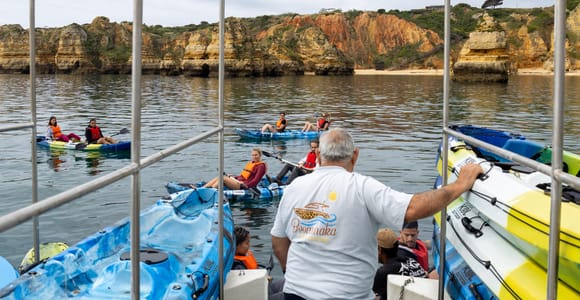
This matters more than it sounds. Everything this site is mostly about — the boat trips to Ponta da Piedade, the dolphin trips, the kayak tours — departs from a pontoon you walk to. A car sits in a paid space while you are out at sea.
The town bus: ONDA
Lagos runs its own municipal network under the name ONDA, with ten numbered routes. A single fare is either €1.20 or €1.60 depending on distance. If you expect to use it repeatedly there are passes: €3.00 for one day, €7.50 for three, €10.00 for five and €15.00 for seven.
The one that matters for a beach holiday is route 2, which links Meia Praia, the railway station, the bus station, Portas de Portugal at the edge of the old town, Praia Dona Ana and Porto de Mós. That single line covers the town beach and two of the cove beaches.
Two limitations worth knowing before you rely on it:
- Sunday service is thin. Route 2 runs on Sundays only in July and August. Several other routes do not run on Sundays at all. If your one free day is a Sunday in May, the bus is not your plan.
- No ONDA route reaches Ponta da Piedade. The nearest stop is Praia Dona Ana, and from there it is around 1.5 km on foot to the headland. That walk is pleasant along the clifftop and it is how a lot of people do it — see Ponta da Piedade on foot — but it is a walk, not a drop-off.
For the headland specifically there is also a hop-on hop-off tourist road train from around €6, which does go up there. It is slow and it is aimed squarely at visitors, but it solves the one gap the bus network leaves.
The train
Lagos is the western terminus of the Linha do Algarve and the station is in town. Trains run east along the coast through Portimão, Silves and Albufeira to Faro. Lagos to Faro takes roughly an hour and forty minutes — slow regional trains that stop nearly everywhere — and the fare has recently been quoted at around €8 one way. Fares are set by CP and posted at the station; booking early changes nothing.
For Silves and Portimão this is genuinely easier than parking there. For Faro it is a long sit.
Getting here from Faro airport
This is the part that catches people out: Faro airport has no railway station. The train is only an option once you have got yourself into Faro town first.
The realistic choices are a direct coach — roughly two to two and a half hours, around seven departures a day, somewhere in the region of €5 to €10 — or a private transfer, which in our listings starts at about €58 for the car rather than per person and takes about an hour and a half.
Landing late with tired children, the transfer is worth it whatever you decide about the rest of the week. Landing at midday, the coach is fine.
Going west without a car
Bus 47 runs from Lagos bus station to Sagres in roughly 45 to 60 minutes; the fare has recently been listed at around €6 one way, set annually by the regional transport authority. A few departures a day continue the last six kilometres to Cabo de São Vicente, and that extension is seasonal rather than year-round — check the timetable before you count on it, or those last six kilometres become a taxi.
Bus 51 reaches Alvor in a good 25 minutes.
So Sagres, the cape in season, Alvor, Portimão and Silves are all doable without a car. That is a real list, and it covers most of the postcard.
What genuinely needs a car
Here is where the honesty earns its place. These do not work on public transport from Lagos:
- The Costa Vicentina beaches. Praia da Bordeira, Praia do Amado, Praia da Arrifana. Buses serve the villages of Aljezur and Odeceixe; they do not serve the beaches, which are several kilometres further on.
- Carvoeiro and Praia da Marinha. There is no useful direct connection from Lagos.
- The inland villages and Monchique, on any schedule you would choose yourself.
- Slide & Splash and Zoomarine, both entry tickets with no transfer and both a fair way east.
One piece of good news for anyone who does drive: the A22 motorway along the Algarve has been toll-free since 1 January 2025, so the electronic transponder question that used to come with every Portuguese rental no longer applies here. A lot of guidebooks have not caught up.
Where a car becomes a liability
In July and August, the historic centre is the wrong place to own a vehicle. The centre is largely pedestrian and the practical approach is to park on its edge and walk in. The municipal company Lagos em Forma runs the paid surface zones and the Frente Ribeirinha and Anel Verde/Praça d’Armas car parks; tariffs were raised in 2023, the first change since 2010, and a high season was introduced at Anel Verde. Rates are posted at the machines — check them there rather than trusting a figure from a blog.
A car you park at nine in the morning and collect at six in the evening has cost you money and given you nothing that day.
So: the rule of thumb
Count the days you would actually drive. If the answer is one, a taxi or a day tour is cheaper and you will not spend the week thinking about parking. If the answer is three or more — west coast, inland, a couple of beaches east — a car pays for itself and buys you the early starts that make those places bearable in summer.
If you land on the second answer, it is worth comparing rental prices for Lagos before you arrive rather than at the desk. What the desk adds to the headline price is a separate subject, and a more expensive one.
The answer is different for you if: you are travelling with a baby and a lot of equipment, in which case the door-to-door convenience outweighs most of the above; you are here for surfing on the west coast, in which case it is not optional; or you are here for three nights in the old town in October, in which case a car is an expense with no matching day to spend it on.