What to see in the Algarve: what is really worth it from Lagos
Updated September 4, 2026 · 8 min read
On any map the Algarve looks like a tidy strip. In reality it runs about 150 kilometres from Sagres to the Spanish border, and Lagos sits far to the west, not in the middle. That is the one sentence you need for planning: everything west is close, and every hour east gets charged twice.
This article sorts the region’s sights by what matters from Lagos: driving time, whether you need a car, admission, time to set aside, and when it gets busy. What lies in Lagos itself is left out here — that is covered in What to see in Lagos. This piece starts where you get in the car.
The west: close, wild, and mostly free
Sagres and Cabo de São Vicente
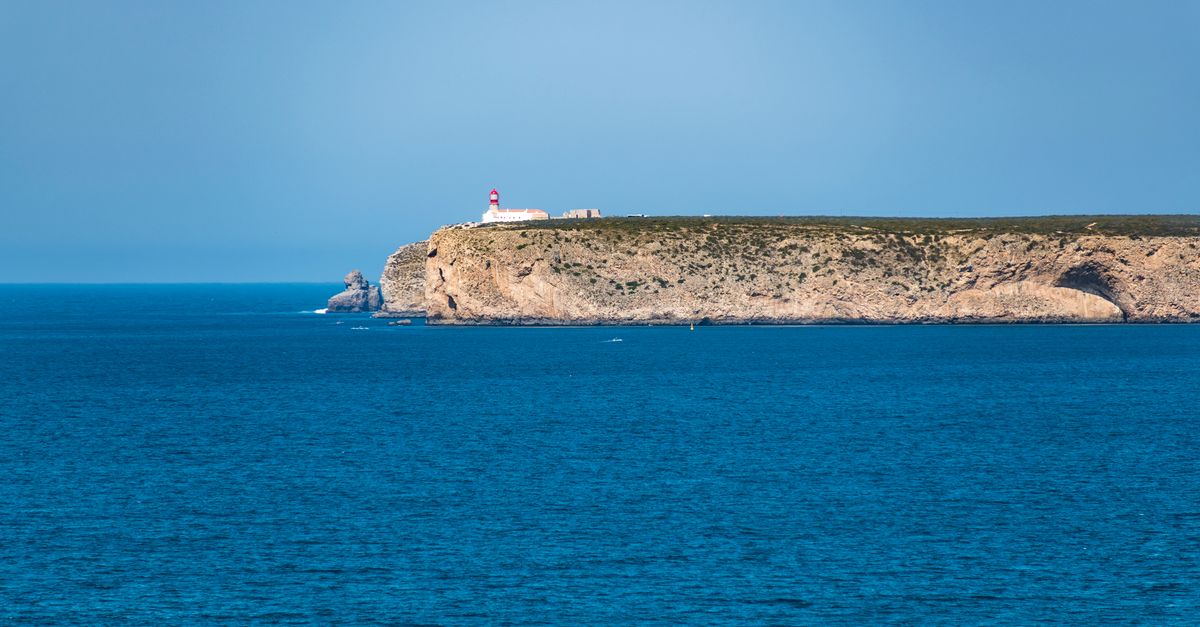
Sagres sits about 33 to 34 kilometres west of Lagos, roughly 40 minutes via the N125 and the N268. Cabo de São Vicente adds another six kilometres, making it the south-westernmost point of Europe — and the nearest major sight from Lagos, closer than anything to the east.
The cape itself costs nothing: cliffs, car park and view are open around the clock. The lighthouse complex, with museum, café and toilets, was closed until further notice as of summer 2026 — check before you drive out. The Fortaleza de Sagres is billed separately, most recently €10 for adults, €5 concession, free under twelve. Prices and hours change; check the official website.
Time needed: half a day for fortress and cape together. It gets busy at the cape around sunset from June to September; go in the morning to have it to yourself. It is almost always windy there, even when Lagos is still — pack a jacket, even in July.
Without a car: bus 47 runs from Lagos bus station to Sagres, roughly 45 to 60 minutes. Only a few departures a day continue the last six kilometres to the cape, not every weekday. Check the timetable, or those last six kilometres become a taxi ride.
The Costa Vicentina
The west coast north of Sagres is the side the postcards do not show: Atlantic swell instead of sheltered coves, dunes, wind, little development. From Lagos it is surprisingly close. Praia da Arrifana lies about 36 kilometres north, a good 40 minutes. Praia do Amado and Praia da Bordeira near Carrapateira are 45 to 55 minutes away, and Odeceixe on the Alentejo border a good hour. All the beaches are free, with parking up on the cliffs; the way down to Arrifana is a steep road on foot.
This is surf and hiking coast, not for small children: colder water than the south coast, stronger currents, no shade. In return you stand here almost alone while the south coast is packed. A car is essential — buses run to Aljezur and Odeceixe, not to the beaches themselves.
The middle: half an hour to an hour
Alvor
About 20 kilometres east, roughly 25 minutes, right on the edge of Portimão. The reason to come is not the town but the boardwalk through the Ria de Alvor: several kilometres of wooden walkway through dunes and lagoon, free, free parking, largely flat and step-free. For pushchairs and unsteady knees, it is the easiest nature walk on the western Algarve.
Time needed: one to two hours. No shade, so in summer go morning or the last hour before sunset. Without a car works well here — bus 51 runs Lagos to Alvor in a good 25 minutes.
Silves
About 35 minutes by car or by train. Silves was the old Moorish capital of the region, inland on the Arade river, with a red sandstone castle above the rooftops. Admission was most recently €2.80 for adults, €1.40 concession, free under 14; hours are seasonal, extended into the evening in high summer.
A note on the train: the station lies about two kilometres outside town, and the walk in climbs alongside a busy road. With children, or at 35 degrees, plan a taxi or connecting bus.
Time needed: half a day. It is never really crowded. Silves suits a day when the wind churns up the sea — not rare, as our article on boat tours and rough seas shows.
Monchique and Fóia
About 45 kilometres, 45 to 60 minutes on winding mountain roads. From Monchique it is another eight kilometres, just under a quarter hour, up to Fóia, at 902 metres the Algarve’s highest point. At the top: transmission masts, a kiosk, and sea views on clear days — little to see in haze. Both are free.
The Serra de Monchique is noticeably cooler than the coast, the right plan for August days when the beach becomes something to escape. Time needed: half a day to a full day.
Carvoeiro, Praia da Marinha and the Seven Hanging Valleys trail
Praia da Marinha lies about 34 kilometres east, 35 to 40 minutes away. It is the most photographed beach in the Algarve, and packed accordingly in high summer — the car park fills by nine, after which access is sometimes closed. Go early, or not at all.
The real reason for the trip is the Percurso dos Sete Vales Suspensos, the clifftop trail between Praia da Marinha and Praia do Vale de Centeanes: about 5.7 kilometres each way, two and a half to three hours one-way, moderately demanding, almost no shade. It passes above Benagil Cave. Sturdy shoes, water, a hat — best avoided in July altogether.
Carvoeiro sits right next door, a good 40 minutes from Lagos. Public transport is awkward here, with no useful direct connection. A car is needed here.
Benagil
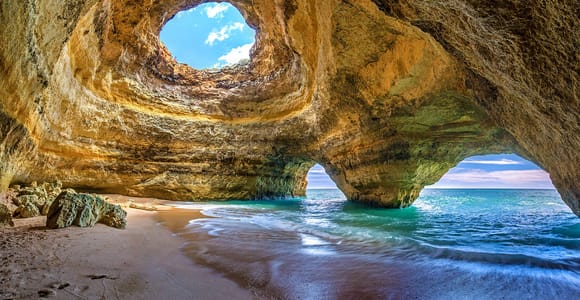
The cave with the hole in its roof lies about 35 kilometres east of Lagos — 30 to 45 minutes by road, or about 30 minutes each way by fast boat. Lagos is expressly not the nearest harbour to it; Portimão and Carvoeiro sit much closer, and boat trips starting directly from Carvoeiro cost from €35 instead of a longer approach.
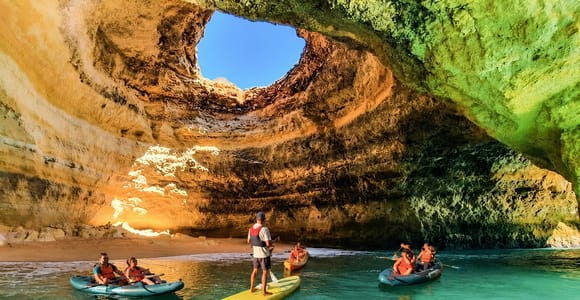
Since 2024 a two-minute rule applies to motorboats inside, and getting out or swimming in is forbidden. A Benagil trip from Lagos takes two to two and a half hours, of which two minutes are spent in the cave. Whether that adds up is covered in From Lagos to Benagil. Anyone who really wants to be inside the cave needs a guided kayak — those start from Benagil itself, from €19.43, under kayak tours.
The family sights with an entry fee
Two large parks lie to the east. Slide & Splash near Lagoa is about 25 kilometres away, roughly 30 minutes, tickets from €32. Zoomarine near Guia, close to Albufeira, is about 55 kilometres away, 45 to 55 minutes, from €28.90. Both are entry tickets only, no transfer — without a rental car add a bus or taxi. In total 39 such experiences and tickets are on offer, from €6, all under things to do in Lagos.
What honestly is not worth it from Lagos
The eastern Algarve. Tavira is about 110 kilometres away, a good 70 minutes on the A22 — each way. Faro takes about 55 minutes, the Ria Formosa sits in the same corner, and the Spanish border at Castro Marim another 30 kilometres on.
Doable on paper, disappointing in practice: two and a half to three hours in the car for a town ticked off in the midday heat. The Ria Formosa also needs a boat trip booked in advance. The train makes it longer, not faster — Lagos to Faro takes roughly 1:35 to 1:50 hours depending on the connection.
The honest recommendation: if the eastern Algarve is on your list, spend two nights there instead. As a day trip from Lagos it is a poor idea, and the same goes for Seville. Also overrated: Albufeira’s old town, a 45-minute drive for a pedestrian street found closer to home.
Without a car: what is left
Without a rental car, you can realistically reach: Sagres with bus 47, Alvor with bus 51, Silves and Portimão by train — and everything by water. The boats leave from the marina, not a car park.
There are 61 sea cave and coastal boat trips from €16, median €38, with over 48,000 reviews: boat trips from Lagos. Also 10 dolphin-watching trips from €25.60, 13 catamaran tours from €20, and 9 sunset cruises from €20 for the evening you would rather not drive. Which boat suits which purpose: Which boat actually gets into the grottoes?; the free land option: Ponta da Piedade on foot.
One point on rental cars: the A22 has been toll-free since 1 January 2025, so the transponder question that used to come with every Algarve rental no longer arises. Guidebooks and older advice pages still say otherwise. The N125 alongside it is free too, just slower.
How I would plan a week
Two days stay around Lagos. One day goes west: Sagres, Cabo de São Vicente, and a Costa Vicentina beach on the way back. One day goes inland, Silves or Monchique depending on the weather. One day goes east, but only as far as Carvoeiro and Praia da Marinha, with an early start. One day stays free for the water — scheduled around the forecast, not the calendar.
Which month allows which of these days is covered in Best time to visit Lagos. What is waiting in the town itself is in What to see in Lagos.
All figures on admission, timetables and opening hours are as of September 2026 and may change — for sights with an entry fee, check the official website the evening before.