What to See in Lagos: The Town Most People Drive Straight Past
Updated September 4, 2026 · 11 min read
Most people come to Lagos for the rocks and see nothing of the town but the car-park-to-jetty path. Understandable — and it’s the priciest mistake, because the old town costs almost nothing to see between two boat trips.
Lagos was once capital of the Algarve, departure port for the caravels, and the site of Europe’s first documented sale of abducted Africans, in 1444. More survives than you’d expect, and less than you’d hope: an earthquake and an eleven-metre wave destroyed most of the town in 1755. Much of what stands inside the walls today is reconstruction.
This is about the town itself: getting there, admission, timing, crowds. The region around it — Sagres, Cabo de São Vicente, Silves, Monchique, Benagil — is covered in what to see in the Algarve.
How much time the town needs
The old town is small. Walking straight through takes forty minutes. The two museums plus a full loop of the walls take half a day — town in the morning, water or beach in the afternoon. A full day only pays off with the morning market, or if weather rules out every boat trip; what’s still possible then is in boat trips and rough seas.
The old town and the town walls
The historic core sits inside the walls and is largely pedestrianised. Around one and a half kilometres of defensive wall enclose it, medieval in parts, though its current form dates mainly from the 16th century and the rebuilding after the earthquake.
Honestly: you cannot walk the top of the wall as you can in Óbidos. The only freely accessible part is the Porta de São Gonçalo; the rest is viewed from below. The governor’s palace, from which Dom Sebastião set off for Morocco in 1578, now sits inside the town hospital and isn’t open to visitors.
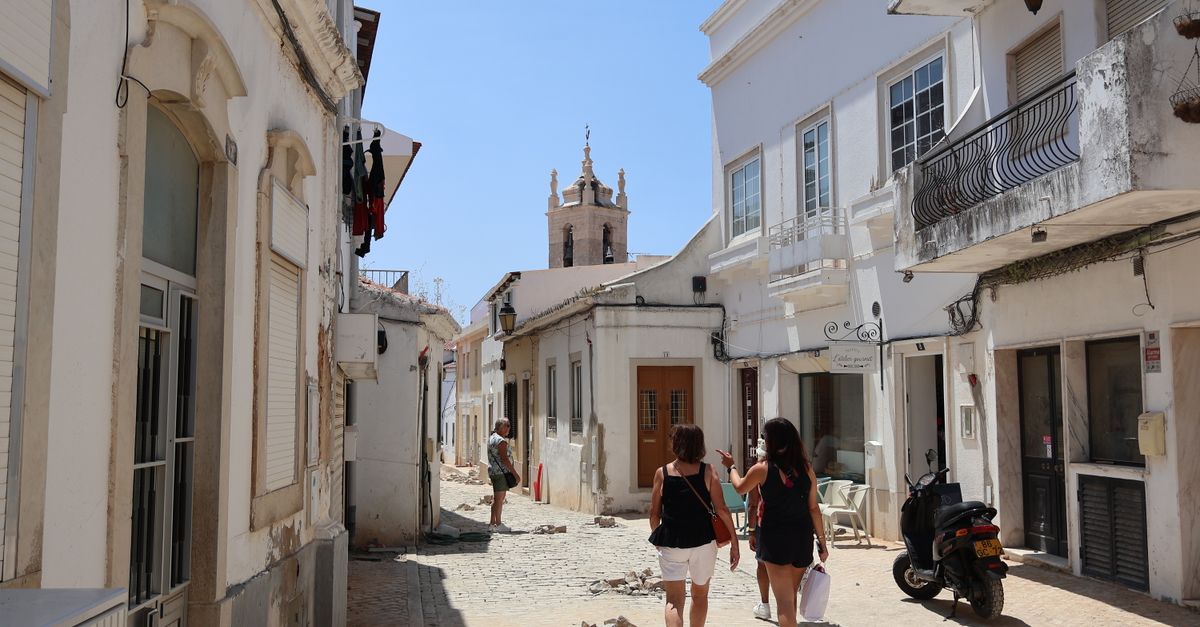
What makes the walk worthwhile are the lanes in between: cobbles, whitewash, washing lines, tiles. Best early morning or after 6pm — between 11am and 4pm in July and August it’s cramped, hot and crowded. Cost: nothing.
Praça Gil Eanes and Praça da República
Praça Gil Eanes is the main square in front of the town hall, named after the navigator who first rounded Cape Bojador in 1434. At its centre stands the sculpture of King Dom Sebastião by João Cutileiro, put up in the early 1970s — the most argued-over object in town: a young king as an angular, almost doll-like armoured figure. Some consider it the finest sculpture south of the Tagus, others a failure.
A short walk further is Praça do Infante Dom Henrique, often called Praça da República: the 1960 monument to Henry the Navigator, the Igreja de Santa Maria, and, on the corner, the real reason to come here.
Mercado de Escravos — the museum you shouldn’t skip
On the square’s edge stands a 17th-century arcaded building, originally the seat of royal customs oversight, later a customs house. Since June 2016 it has housed the Núcleo Museológico Rota da Escravatura, created with UNESCO’s “Slave Route” project.
The facts: on 8 August 1444, around 235 people abducted from what is now Mauritania were publicly sold and divided up here — families were separated in the process. Chronicler Gomes Eanes de Zurara described the scene, calling it hard to bear before justifying it. Lagos is considered the site of Europe’s first documented slave market. The building is younger than the event — the sale took place on the square outside, not inside this arcade.
The tour includes the Vale da Gafaria outside the walls. In 2009, building an underground car park uncovered more than 150 skeletons, buried among municipal waste; investigations confirmed African origin. A car park now stands on the site.
Practical details: Tuesday to Sunday, 10am–1pm and 2–6pm, closed Mondays. Full price €3, concessions €1.50, children under twelve free; a combined ticket with the town museum costs €5. Prices and hours, set by the Museu de Lagos, can change. Allow 45 minutes. The permanent exhibition is upstairs via an outdoor staircase; anyone unable to manage it can borrow a VR headset at the desk instead.
This isn’t an easy visit with children — the exhibition doesn’t soften anything.
Igreja de Santo António and the town museum
From outside, the Igreja de Santo António is a plain white church on a side street. Inside it’s the opposite: gilded carving across every wall, a painted false dome on the ceiling, a blue-and-white azulejo base. The 1718 altarpiece survived the earthquake; the rest was restored in 1769. A national monument since 1924.
The key point: the only way in is through the museum. It has no separate visitor entrance — it’s part of the Museu Municipal Dr. José Formosinho, an old-fashioned collection of archaeology, folk art, church treasures and curiosities in glass cases. Some love that; others walk briskly through to the church. Here too it’s €3 full price, €1.50 concessions, same hours, last entry half an hour before closing. An hour covers both.
Forte da Ponta da Bandeira: currently closed
The small fort by the water, reached over a wooden bridge, defended the harbour entrance from the 17th century. It’s in every guidebook — and it’s currently closed. The Museu de Lagos lists it as temporarily closed, no reopening date; the town is restoring the façade and planning a museum redesign. For planning: look at it from outside, move on. Before you travel, check the museum’s website — this may have changed.
Marina de Lagos and crossing the river
The marina sits on the Bensafrim’s eastern bank, opposite the old town, a few minutes over the footbridge from Praça do Infante. It’s where many boat trips depart, and the easiest way to reach Meia Praia.
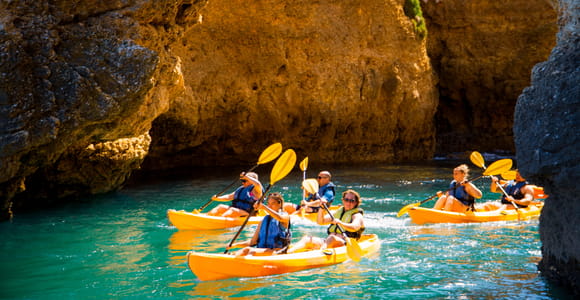
As a sight, it honestly isn’t one — pontoons, restaurants, shops, sailing boats. Pleasant evenings, unremarkable midday. Anyone interested in boats finds the full range: 119 trips from Lagos, cheapest from €6. The selection splits into Ponta da Piedade boat tours (65 options, from €16), dolphin watching (10 options, from €25.60), catamaran tours (from €20), sailing trips (8 options), kayak tours (26 options, from €19.43) and sunset cruises (9 options, from €20). Prefer to go alone: private boat tours start at €390.
Meia Praia
The town beach is the opposite of the famous coves: around four and a half kilometres of pale sand, a shallow entry, no steps, no cliff. About ten minutes on foot from the marina, or in summer a small ferry crosses the channel.
The water isn’t warm even in August — the Atlantic here sits well below Mediterranean temperatures. Everything else, from bus routes to the railway crossings behind the beach, is in Meia Praia with children.
Mercado Municipal
The market hall on Avenida dos Descobrimentos, built in 1924, is the best place in Lagos to stop being a tourist for ten minutes. Fish on the ground floor, fruit, vegetables, cheese and oil on the first floor, and a restaurant on top with a view over the bay.
Timing matters: Monday to Saturday mornings, the earlier the better, closed Sundays; sources vary on closing time, between 2pm and 3pm. Free admission, allow fifteen minutes.
Ponta da Piedade — just briefly here
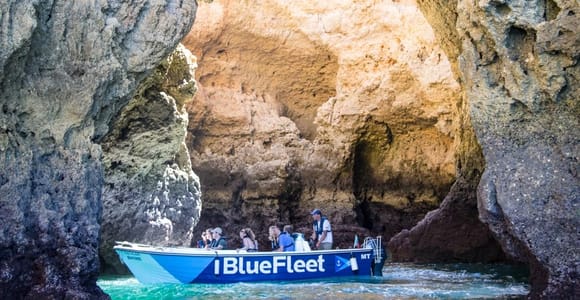
The headland with the rock stacks lies outside town, a good half-hour’s walk away, and it’s the one point where Lagos meets every expectation. It has its own articles here, so just the short version: from above, everything is free and open around the clock — details in Ponta da Piedade on foot. You get further with a pushchair than you’d think: with a stroller. And to get inside the caves rather than just past them, it all comes down to boat type: which boat gets into the grottoes.
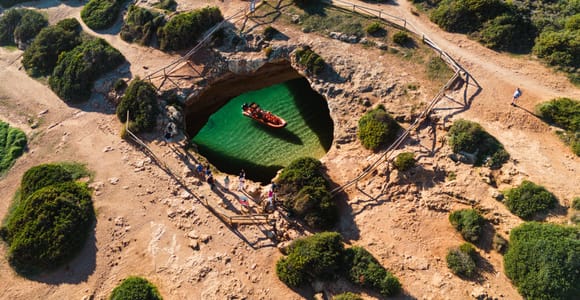
What Lagos is not: the closest port for Benagil. The famous cave lies around 35 kilometres east — Portimão and Carvoeiro are closer. Whether the longer trip from Lagos is worth it is in from Lagos to Benagil.
Getting there, parking, crowds
On foot. Everything here except the headland lies within twenty minutes’ walk. You don’t need a car in town — only to leave it.
By train or bus. The railway and bus stations are on the eastern bank; over the marina bridge it’s about fifteen minutes’ walk into the old town.
By car. The old town is pedestrianised — you can’t drive in. The paid car park at the marina is most convenient; free spaces lie further out towards Estrada de Sagres and Meia Praia, eight to fifteen minutes on foot. In July and August the central spaces fill before 10am. One necessary warning: near the marina, people in hi-vis vests wave cars into spaces, then ask for a “tip”. They have nothing to do with it.
When it’s busiest. July and August, plus midday and the days cruise passengers arrive from Portimão. Which months work best is in best time to visit Lagos.
What isn’t worth it
The little tourist train covers ground you can walk in the same time — and walking is the better part anyway. The souvenir streets around Rua 25 de Abril sell the same things in every other shop. Anyone coming only for the town walls will find them smaller than expected.
On the other hand: two museums for €6 combined, a church like a jewellery box, a morning market and a square with a contentious statue — that’s worth the half day. Everything else Lagos offers in guided experiences is on the things to do in Lagos page: 39 options, cheapest from €6.